Thank you for taking the Golf Fitness Evaluation series of tests. Perhaps, for the first time, you will begin to understand your golf specific strengths and weaknesses and how they may be contributing to your current golf game.
Some of these exact tests are used by elite trainers and physical therapists for their tour professional clientele. We would like to thank the Chek Institute for making these available. Each of these tests was specifically designed to evaluate your range of motion in the specific joints that most affect the golf swing.
Other tests evaluate your balance and coordination, strength and endurance and overall fitness as it relates to your ability to play better golf. Be proactive and begin the exercises and stretches recommended in each area if your results deliver less than optimal performance.
Remember that no one golfer is perfect, so narrow your focus to those key areas where you most need improvement. Rebuild your body beginning with your weakest physical link and you may be surprised with the enhanced performance of your game.
Use the results from these tests as a supplement to the workout recommended to you after taking the Personal Fitness and Golf Questionnaire.
Here’s how to interpret your results:
 Stop. This is an obvious area of weakness for you and may be contributing to swing faults. Set corrective exercises and stretches designed to improve this area at the top of your priority list moving forward.
Do not move into more advanced exercises or stretches until you get a yellow or green light to progress further.
 Proceed with Caution. By working to improve your body’s weaknesses, you create an opportunity for improvement in your game.
Continue with exercises and stretches in this area until you get the green light to move forward.
 Go! You’re doing a great job so far of keeping your body strong and/or flexible. You can continue working on your strength and flexibility, but all priorities should be placed on immediate improvement of your weak links.
Please review all results with a “red” or “yellow” result.
NB: if you have changed your selection and don’t see any changes here, please click on the Refresh button in your browser and you should see your new results.
Core Muscle Activation
CORE-ACTIVATION TEST A
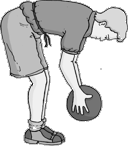 Your result: [showContent tags=”611″] Stop
I feel the string around my waistline tighten[/showContent][showContent tags=”613″] Proceed with Caution
The string around my waistline feels the same either way[/showContent][showContent tags=”615″] Go!
I feel the string loosen around my waistline[/showContent]
One of the areas that has the potential to separate golfers at the more elite levels of golf is the strength and endurance of a players’ core. Almost every player I evaluate whose handicap is a single digit number has the ability to actively engage the core.
What separates the next echelon of serious contenders in competition is the ability to not only engage the core, but for an extended period of time while producing motion throughout other parts of their body, just like the golf swing. This test reflects your ability and understanding of how to actively engage your core region.
When your core is actively engaged, you should feel your belly button being contracted in and towards your low back which means you should feel the string loosen. This is proper engagement of the core.
If you felt the string tighten or if the string felt the same way throughout this test, here is a link to some specific core programs that you can use to produce more strength in your core.
CORE ACTIVATION TEST B
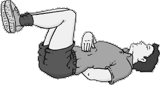 Your result: [showContent tags=”617″] Stop
My lower back lifted and I could feel some pressure on my hand[/showContent][showContent tags=”619″] Proceed with Caution
Lower back lifted and I could feel some pressure on my hand[/showContent][showContent tags=”621″] Go!
I kept the same pressure on my hand as I lifted[/showContent]
This evaluation serves as your second core based test. You should be able to lower your feet towards the floor while keeping the same pressure on your hand beneath your low back. If you are unable to do so, this means that the abdominal muscles are most likely too weak to dissipate forces away from the spine or to generate optimal force during the golf swing.
Keep in mind that true power can not be achieved until you have proper strength and endurance in your core. You also become very susceptible to low back injuries when you don’t have enough strength and endurance.
So, what happens if you pass the first test and fail the second? It is likely your body has some concept of proper core engagement but it is still not producing the consistency you need to produce one good quality shot one after the other.
Make note of how you performed on the first test compared to this test. If you achieved less than Birdie performance on both, you should set core strength exercises as a priority moving forward. If you passed one test and failed the other, continue focusing on these exercises until you pass both tests.
To increase the strength and endurance of your core region, here is a link to some specific core programs that you can use.
CORE STRENGTH & ENDURANCE TEST C
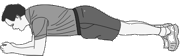 Your result: [showContent tags=”623″] Stop
30 seconds or less[/showContent][showContent tags=”625″] Proceed with Caution
Between 31 and 60 seconds[/showContent][showContent tags=”627″] Proceed with Caution
Between 61 and 90 seconds[/showContent][showContent tags=”629″] Go!
Over 90 seconds[/showContent]
As you’ve already learned, core strength is an important part of a golfer’s posture and base of power. Once strength is built in this area, a natural question arises. How long can the core continue to produce this strength which is an assessment of your strength endurance.
Keep in mind that true power can not be achieved until you have proper strength and endurance in your core. You also become very susceptible to low back injuries when you don’t have enough strength and endurance.
If you possess good core strength and endurance, you should be able to hold this plank position without any discomfort in your back for up to 90 seconds or more. To increase the strength and endurance of your core region, here is a link to some specific core programs that you can use.
Muscle Balance & Flexibility
SEATED SPINAL ROTATION TEST
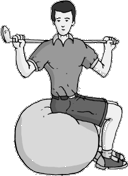 Your result: [showContent tags=”631, 637″] Stop[/showContent][showContent tags=”633, 639″] Proceed with Caution[/showContent][showContent tags=”635, 641″] Go![/showContent]
Left: [Infusionsoft_user_details_output item=”_SeatedSpinalRotationTestLeft”]
Right: [Infusionsoft_user_details_output item=”_SeatedSpinalRotationTestRight”]
Your spinal rotation is one of the most important flexibility points in your golf swing. If you are noticing a need or desire for increased distance, this is the likely culprit. Most pros rotate their lower body 45 degrees with a 90 degree shoulder turn.
Tiger Woods has a reported 30 degree hip turn with a 90 degree shoulder turn. What is most important is the difference between the shoulder turn and hip turn. This is what creates the unwinding effect which leads to increased distance. Keep in mind, while most people refer to this as a good shoulder turn, it is really your lower back or spinal flexibility that allows you the opportunity to produce this turn.
Next, take a look at whether your left side equals your right side. For example, if your left turns to 9:00, your right should turn to 3:00. This means they are equal turns to each direction. Similarly, if you turn to 11:00 and 2:00 this would be equal. So, there are two things you should be looking at.
Can you make adequate rotation at the spine to produce maximum distance? Secondly, are you achieving the same rotation on each side? If you see a discrepancy on either side, make sure you show preferential stretching time to the tighter side. Here are some stretches to increase your spinal flexibility.
SHOULDER ROTATION TEST-INTERNAL
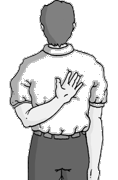 Your result: [showContent tags=”643, 649″] Stop[/showContent][showContent tags=”645, 651″] Proceed with Caution[/showContent][showContent tags=”647, 653″] Go![/showContent]
Left: [Infusionsoft_user_details_output item=”_ShoulderRotationTestInternalLeft”]
Right: [Infusionsoft_user_details_output item=”_ShoulderRotationTestInternalRight”]
Normal internal rotation of the shoulders will allow you to reach behind your back and touch the opposite shoulder blade. If you are reaching at or around your belt loop or significantly below your shoulder blade, it is time to work on this area.
Restricted shoulder range of motion is a very common problem with golfers at all levels. When the shoulders are restricted, common swing faults such as hooks and slices have a greater chance of occurring. Consistency can also be a problem.
Additionally, poor shoulder rotation can have an effect on posture. When a golfer has tight chest and shoulder muscles, they can give the appearance of forward stooped shoulders and sunken in chest.
When golfers have difficulty with shoulder range of motion, a compensation for this lack of rotation is often excessive rotation of the spine. As you can see, it becomes one compensation after the other which forces the body to breakdown in injuries as well as prevents the golfer from achieving an optimal swing plane. Click here for specific shoulder stretches.
SHOULDER ROTATION TEST-EXTERNAL
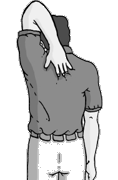 Your result: [showContent tags=”655, 661″] Stop[/showContent][showContent tags=”657, 663″] Proceed with Caution[/showContent][showContent tags=”659, 665″] Go![/showContent]
Left: [Infusionsoft_user_details_output item=”_ShoulderRotationTextExternalLeft”]
Right: [Infusionsoft_user_details_output item=”_ShoulderRotationTestExternalRight”]
Normal external rotation of the shoulders is shown by reaching behind your head and neck and over to the top inside corner of your shoulder blade. Poor external shoulder rotation can wreak havoc on your golf swing by affecting both your backswing and follow through which both have an impact on ball flight.
Restricted shoulder range of motion is a very common problem with golfers at all levels. When the shoulders are restricted, common swing faults such as hooks and slices have a greater chance of occurring. Consistency can also be a problem.
Additionally, poor shoulder rotation can have an effect on posture.
When a golfer has tight chest and shoulder muscles, they can give the appearance of forward stooped shoulders and sunken in chest. When golfers have difficulty with shoulder range of motion, a compensation for this lack of rotation is often excessive rotation of the spine.
As you can see, it becomes one compensation after the other which forces the body to breakdown in injuries as well as prevents the golfer from achieving an optimal swing plane. Click here for specific shoulder stretches.
HIP ROTATION-INTERNAL
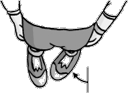 Your result: [showContent tags=”667, 673″] Stop[/showContent][showContent tags=”669, 675″] Proceed with Caution[/showContent][showContent tags=”671, 677″] Go![/showContent]
Left: [Infusionsoft_user_details_output item=”_HipRotationInternalLeft”]
Right: [Infusionsoft_user_details_output item=”_HipRotationInternalRight”]
It is difficult to load the powerful muscles of the hip without adequate range of motion. Tight hip rotators will limit your backswing and follow through with an eventual loss of swing plane as the body looks for ways to compensate for its loss of motion.
When hip rotators are tight, golfers usually see additional stress placed on the back and shoulders. Has an instructor ever mentioned your overuse of arms when swinging the club? This could be another possible culprit.
If you are a senior golfer with low back pain, pay attention to this area as it can be significant in producing overuse injuries to the spine and shoulders. Here are some stretches to increase your hip rotation.
HIP ROTATION-EXTERNAL
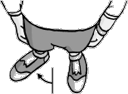 Your result: Left: [showContent tags=”679″] Stop[/showContent][showContent tags=”681″] Proceed with Caution[/showContent][showContent tags=”683″] Go![/showContent] | Right: [showContent tags=”685″] Stop[/showContent][showContent tags=”687″] Proceed with Caution[/showContent][showContent tags=”689″] Go![/showContent]
Left: [Infusionsoft_user_details_output item=”_HipRotationExternalLeft”]
Right: [Infusionsoft_user_details_output item=”_HipRotationExternalRight”]
It is difficult to load the powerful muscles of the hip without adequate range of motion. Tight hip rotators will limit your backswing and follow through with an eventual loss of swing plane as the body looks for ways to compensate for its loss of motion.
When hip rotators are tight, golfers usually see additional stress placed on the back and shoulders. Has an instructor ever mentioned your overuse of arms when swinging the club? This could be another possible culprit.
If you are a senior golfer with low back pain, pay attention to this area as it can be significant in producing overuse injuries to the spine and shoulders. Here are some stretches to increase your hip rotation.
CHEST (PEC MINOR AND MAJOR) TEST
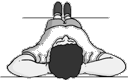 Your result: [showContent tags=”691, 697″] Stop[/showContent][showContent tags=”693, 699″] Proceed with Caution[/showContent][showContent tags=”695, 701″] Go![/showContent]
Left: [Infusionsoft_user_details_output item=”_ChestTestLeft”]
Right: [Infusionsoft_user_details_output item=”_ChestTestRight”]
When your chest and shoulder muscles are tight, swing faults begin to creep their way into your golf swing. If both forearms are unable to lay flat on the floor, then some restrictions have already come into play.
Notice how your right side compares to your left. Can you touch completely on one side and not the other? These are the clues that your restrictions may be taking place in one area of your body. Those golfers with rounded shoulders and more forward posture will find difficulty in performing this test.
Continue with stretches for the chest and shoulder area to achieve maximum flexibility. Click here for chest and shoulder stretches.
NECK ROTATION TEST
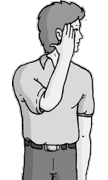 Your result: Left: [showContent tags=”703″] Stop[/showContent][showContent tags=”705″] Proceed with Caution[/showContent][showContent tags=”707″] Go![/showContent] | Right: [showContent tags=”709″] Stop[/showContent][showContent tags=”711″] Proceed with Caution[/showContent][showContent tags=”713″] Go![/showContent]
Left: [Infusionsoft_user_details_output item=”_NeckRotationTestLeft”]
Right: [Infusionsoft_user_details_output item=”_NeckRotationTestRight”]
The majority of competition golfers in this world can rotate muscles in their necks so that their chins are aligned with the seam on their shirt, to the left and to the right. If you are a senior golfer, normal neck rotation will allow for a 70 degree rotation to each side.
In either case, 70 to 90 degree range of motion is normal. Neck rotation is important as it relates to stabilization of the head and maintaining proper spine angles and balance. Golfers have a tendency to take their eyes off the ball during their backswing when they have restrictions with neck rotation.
Ultimately, this has an impact on your swing plane and creates yet another area of restriction contributing to your golf swing. Try one of these neck stretches.
HIP FLEXOR TEST
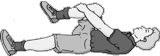 Your result: [showContent tags=”715″] Stop
My leg came straight off the ground several inches[/showContent][showContent tags=”717″] Proceed with Caution
My straight leg came off the ground slightly[/showContent][showContent tags=”719″] Go!
My straight leg stayed in the same position[/showContent]
When you bring your knee to your chest, your opposite leg should remain intact with the floor. If the opposite leg comes off the ground, it is likely your hip flexors are too tight.
If you want to swing the club properly, your hip flexors must remain flexible. Tight hip flexors are a common source of problems with golfers who experience low back pain. When a golfer has tight hip flexors, this creates another muscle imbalance in the body in the form of weak abdominal muscles and more pressure on the spine to perform.
Tight hip flexors can limit your ability to achieve a full backswing as well as a proper follow through. Golfers can experience a loss of distance due to a more restricted spinal rotation. Here are a few stretches for your hip flexors.
HAMSTRING AND LOWER BACK TEST
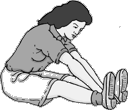 Your result: [showContent tags=”721″] Stop
I could reach near my knees[/showContent][showContent tags=”723″] Proceed with Caution
I could reach between my knees and my toes[/showContent][showContent tags=”725″] Proceed with Caution
I could reach my toes[/showContent][showContent tags=”727″] Go!
I could reach past my toes[/showContent]
The beginning of all golf movement begins with building a solid base of support prior to going through the stages of a proper set up for the swing. When the hamstrings are tight, it forces the body to compensate by rounding the spine. A rounded spine then affects posture at address.
The downward spiral of breakdowns in the body begins with tight hamstrings. Golfers with tight hamstrings typically have a history of low back pain and discomfort in addition to other injuries.
Once tight hamstrings place greater stress on the spine, a loss of flexibility can occur and valuable distance can be compromised. Here’s how to increasehamstring flexibility.
PRESS UP TEST FOR LOWER BACK
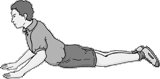 Your result: [showContent tags=”729″] Stop
My arms were very bent at the elbows[/showContent][showContent tags=”731″] Proceed with Caution
My arms were slightly bent[/showContent][showContent tags=”733″] Go!
My arms were mostly straight at the elbows[/showContent]
This press up test is used to assess if a golfer has adequate lumbar extension. If normal extension is lacking, then you will likely experience difficulty in achieving a full range of motion in your backswing and follow through.
As the body finds new ways to compensate, golfers often use excessive shoulder rotation as the body begins to break down. If you possess normal extension of the low back, you should be able to straighten your arms while keeping your pelvis in contact with the floor.
The more you bend your arms, the greater your restriction in this area. Here are some stretches to increase your spinal flexibility.
Muscle Strength And Endurance
UPPER BODY STRENGTH TEST
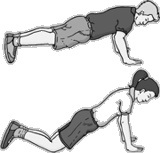 Your result: [showContent tags=”735″] Stop
1-10[/showContent][showContent tags=”737″] Proceed with Caution
11-15[/showContent][showContent tags=”739″] Proceed with Caution
16-20[/showContent][showContent tags=”741″] Go!
Over 20[/showContent]
The push up test is considered a standard in the personal training industry for measuring strength and endurance of the upper body muscles including the chest, shoulders and triceps.If you are a man between the ages of 15 to 39, you should be able to perform between 22 and 30 repetitions for above average strength.
If you are a woman in this age range, work towards completing 20 to 30 push ups from a modified position. For men 40 and older, 10 to 20 push ups reflect good upper body strength and endurance. Ladies who are 40 and older should strive for 8 to 15 push ups.
Combined muscle strength produces balance and coordination. Strong ligaments and tendons also prevent the joints from going beyond their range of motion.
With a strong upper body for golf, you increase your overall power production, decrease your likelihood for injuries, and develop a solid foundation with which to build a stronger skill set. Here are some golf specific strength programs.
LOWER BODY STRENGTH TEST
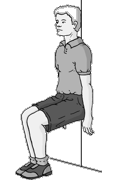 Your result: [showContent tags=”743″] Stop
I maintained this position for less than 45 seconds[/showContent][showContent tags=”745″] Proceed with Caution
I maintained this position between 45 and 75 seconds[/showContent][showContent tags=”747″] Go!
I maintained this position for over 75 seconds[/showContent]
The lower body initiates the downswing and provides a stable base of support for the golf swing. Strength in your upper thigh and glute muscles will lead to increased stamina throughout your round as well as contribute to consistency, power and repeatability in your swing.
Golfers seeking good lower body strength and endurance should strive for a solid 1 ½ to 2 minutes in a squat position with their legs parallel to the floor. If the wear and tear of aging has taken its toll on your knees, try some lying leg lifts to see how your leg strength compares.
Can you lift your thigh muscles in a continuous motion for over 40 repetitions on each side? Combined muscle strength produces balance and coordination.
Strong ligaments and tendons also prevent the joints from going beyond their range of motion. With a strong upper body for golf, you increase your overall power production, decrease your likelihood for injuries, and develop a solid foundation with which to build a stronger skill set. Here are some golf specific strength programs.
ABDOMINAL STRENGTH TEST
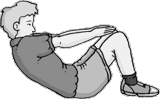 Your result: [showContent tags=”749″] Stop
I performed 0-15 curls ups[/showContent][showContent tags=”751″] Proceed with Caution
I performed 16-30 curl ups[/showContent][showContent tags=”753″] Go!
I performed over 30 curl ups[/showContent]
Building a strong mid section allows golfers to transfer movement and power from the lower body to upper body.
Once strength is developed in this area, balance and coordination are improved. Strength in the mid section controls excessive and needless movement especially in the lower body. The result is less lateral movement throughout the swing.
While strength controls movement, it also prevents common injuries. Many known back problems stem from a weakened mid section. The rotational movement of the golf swing also requires strength to be present so you can capitalize of maximum speed and power as the body unwinds for better distance.
Here are some guidelines for exceptional strength based on gender differences.
Men under the age of 35 should be able to perform 45 to 60 curl ups for optimal results. Men over 35 should be able to perform 30 to 50. If you are a woman under 35, 40 to 50 curl sups would be the gold standard. For ladies older than 35, try to perform 20 to 30 curl ups. Click here to increase your ab strength.
Balance
BALANCE TEST
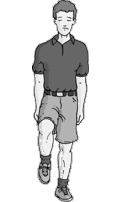 Your result: [showContent tags=”755″] Stop
I maintained my balance between 0 to 10 seconds[/showContent][showContent tags=”757″] Proceed with Caution
I maintained my balance between 11 to 20 seconds[/showContent][showContent tags=”759″] Go!
I maintained my balance more than 20 seconds[/showContent]
Good balance consists of the ability to maintain and control the body’s center of gravity over its base of support. When golfers complain of consistency in their swing, lack of balance and stability is usually the contributing factor.
The most important rule in a golf conditioning program is to work and develop strength from the core region of the body outward. A strong trunk allows forces to be transferred effectively from the legs to the upper body.
It also enables the body to withstand those forces without breakdown. Stabilization comes in many forms for the golfer including postural stabilization, trunk stabilization and joint stabilization.Go back and see how you did on those first two core tests.
Generally speaking, you will typically find that if you performed well on those tests, you also have good balance. You may also find that that you had trouble with the core tests and also lack sufficient balance. If you are 20 to 49 years of age, 24 to 28 seconds is considered good balance.
If you are between the ages of 50 to 59, then 21 seconds is good balance. If you are 60 to 69 years of age, 10 seconds is considered good balance. If you are over the age of 70, then 4 seconds is a normal range for balance.